



When we enter a museum and see the objects on display, we do not, in most cases, think about all the work behind each one. In most cases, this involves a lengthy and complex process of conservation and restoration carried out by specialists.
Conservation aims to restore the physical integrity of the objects, but also to enable their formal and decorative reading, without which it would often be impossible to understand their functionality.
Alongside historical and archaeological research, the Museum of Mértola has always worked in preventive and curative conservation and restoration, on a great variety of materials including ceramics, lithics, metals and alloys, glass, but also archaeological structures and other elements such as mosaics, stuccos, frescoes, among others.
The first intervention on the mosaics of the Alcáçova took place during their excavation in 2001 and 2002, with the aim of preventive conservation and minimizing the impact of their exposure to the open air. In 2008 and 2009, as part of the development of a musealization project and the construction of a protective roof structure, a major conservation intervention was carried out—addressing not only the direct physical impact on the site but also its presentation and interpretation. In 2011, further work was undertaken to correct specific issues that had arisen, as well as to address the effects of open-air exposure on the site. For over four decades, the regular maintenance of the archaeological structures at the Alcáçova was the responsibility of our late colleague, José Filipe—who unexpectedly passed away in April 2025. We take this opportunity to pay tribute to him and express how deeply he is missed.
In 2024, following the arrival of conservator-restorer Beatriz Borges to the Museum team, a phased intervention program was established for the Museum’s collection—encompassing both archaeological structures and *in situ* heritage, with a particular focus on the mosaics at the Alcáçova and the Encosta do Castelo in Mértola. With the collaboration of technicians Guilhermina Bento and Nélia Romba, various maintenance and conservation tasks were carried out—most notably during June and July 2025, with a strong emphasis on the mosaics.
The primary objective of this intervention was to maintain the work previously carried out, as a need for further action had become apparent—stemming from the site’s exposure to the open air, the influence of the metal roof structure, and the natural degradation of the materials themselves. This intervention comprised the following phases:
– Application of biocides to halt the development of biological colonization;
– Inspection and securing of *tesserae*, consolidation of mortars, and chromatic reintegration of previously applied mortars.
This is an ongoing project, requiring regular monitoring and assessment, with the aim of preserving the site and promoting it as one of the primary visitor attractions of the Cláudio Torres Museum of Mértola.
Much of the work carried out in a museum takes place away from the public eye. Before an object is put on display for visitors, it undergoes an extensive process of bibliographic research, assessment, conservation and restoration, helping to preserve the traces of the past and ensure they are passed on to future generations.
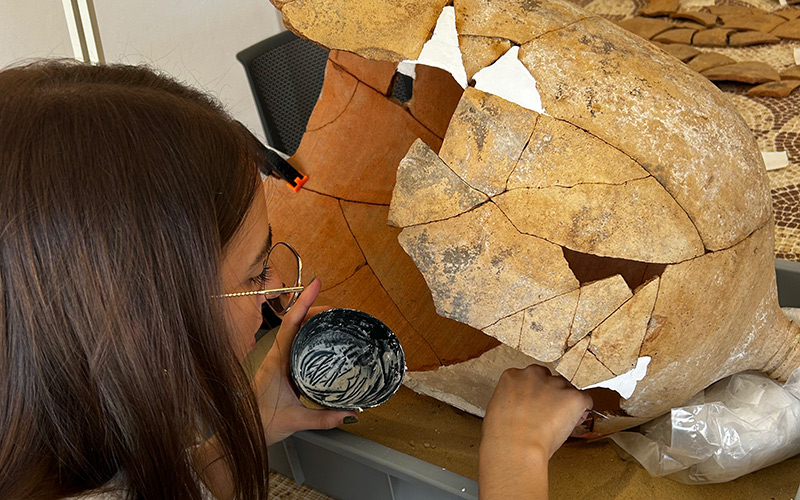
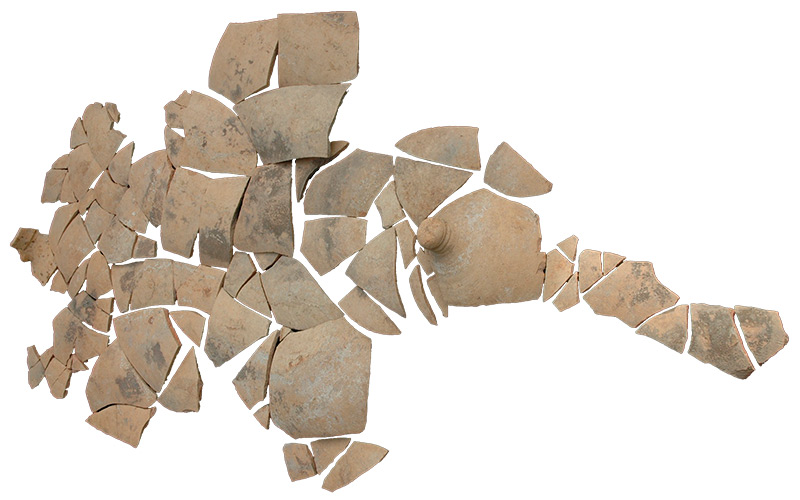
It is within this context that the conservation and restoration of an amphora, classified as Late Roman Amphorae 6, takes place. The amphora was recovered during the second phase of archaeological excavations carried out in 2008 at the former Hospedaria Beira-Rio, on the site now occupied by the Hotel Museu. Dating from between the 5th and 8th centuries AD, it is a wine amphora originating from Palestine.
This work, unseen by visitors, takes place behind the scenes at the Museum and always begins with an assessment of the object’s condition, during which we seek to identify any forms of deterioration affecting it. Based on this assessment, a conservation and restoration treatment plan is then drawn up to guide the work and enable the object to be fully reassembled – even if some parts are missing.
This process, often unknown to the public, is a fundamental part of a museum’s operations, enabling it to fulfil its responsibilities for conservation,cataloguing, research and public engagemen The work carried out ‘behind the scenes’ is essential to understanding an object’s context and function, ensuring its preservation, preparing it for display and facilitating engagement with different audiences.