



Networks and Partnerships
MÉRTOLA MUSEUM
The work developed by museums should include relations with other museological units, as well as regional, national and international projects. In this context, and with the aim of broadening its sphere of action, the Museu de Mértola is a member of several networks and develops partnerships and collaborations with public and private institutions.

The Portuguese Museum Network (RPM), created in 2000, is an organized system of museums based on voluntary membership, configured progressively and aimed at decentralization, mediation, qualification, and cooperation among museums. The RPM's objectives are:
- The enhancement and qualification of the national museum landscape;
- Institutional cooperation and coordination among museums;
- Decentralization of resources;
- Planning and rationalization of public investments in museums;
- Dissemination of information related to museums;
- Promotion of rigor and professionalism in museological practices and museographic techniques;
- Fostering collaboration among museums.
The Mértola Museum has been part of the RPM since 2002 and, in this context, has developed several actions, especially the training and qualification of its technicians and the development of projects in the areas of research, dissemination, and preventive conservation.

The collection of rural museums in the Alentejo and Algarve regions is today an extraordinary asset for the region and a further element in diversifying the offerings and dignifying the communities in which they are located. However, given the current social, economic, and functional realities, collaborative work is urgently needed to ensure that the offerings are more diverse, of higher quality, and focused on broader and more universal themes.
Created in 2015, this Network informally integrates the Museum of Rurality (Entradas – Castro Verde), the Alcaria dos Javazes Museum Centre (Mértola), the Pias Rural Museum (Serpa), the Archaeological and Ethnographic Museum of Santa-Clara-a-Nova (Almodôvar), the Flour Museum (S. Domingos – Santiago do Cacém), the Museum of Work (Abela – Santiago do Cacém) and the Ervidel Rural Centre (Aljustrel), and aims to create a network for sharing knowledge and experiences that functions as a workspace to facilitate, streamline and make the work carried out by these museums more comprehensive.

The historical-archaeological research and museum program in Mértola has been based, from its inception, on a strong partnership between the Mértola Municipal Council and the Mértola Archaeological Field.
"Emerging from anonymity, the village of Mértola has been the subject of an experiment that, although prolonged, already allows for a positive assessment. The benefits are becoming evident to the community, and the tourists who visit us in increasing numbers annually have the pleasant surprise of finding places of interest scattered throughout the village and in cultural circuits in the surrounding area.
Our intervention in Mértola began with archaeology, an archaeology that, although naturally stemming from a purely academic approach, was very soon diverted towards didactic objectives. Until then, the program relied solely on the voluntary and seasonal work of a team of volunteers, composed of students from the Faculty of Letters of Lisbon, who, during their holidays or on weekends, carried out interventions in the field in order to gather information. [...] This cyclical movement of people with different habits and cultures who, in general, showed no interest whatsoever in satisfying the curiosity of the local people, created a certain strangeness locally, if not almost complete indifference.
Therefore, from very early on, we..." In the early years, we tried to proceed differently. From our first contacts with Mértola, and also for reasons of political identification, we felt involved in the life and interests of the community. The excavation took place within the settlement, in the location considered by the inhabitants as their collective point of reference, their community soul – the castle and all its direct involvement. By digging in the castle, we were necessarily touching the deepest part of the community, arousing natural and inevitable curiosity. During the first campaigns, we learned to justify our work, listening to the comments and, whenever possible, finding consensus.” (Cláudio Torres in, www.camertola.pt)

The RMBA was created in 2011 and includes the municipalities of Almodôvar, Aljustrel, Alvito, Beja, Castro Verde, Cuba, Ferreira do Alentejo, Mértola, Moura, Serpa, Ourique, Vidigueira and the Queen D. Leonor Museum (Beja), having been integrated into the Intermunicipal Community of Baixo Alentejo (CIMBAL) in 2016. The museums that comprise it are characterized by an interesting thematic and museographic diversity and present similar characteristics in terms of management and resources.
The RMBA acts as a privileged interlocutor with the supervisory bodies of the participating museums, in order to make them aware of the need to preserve, value and disseminate Heritage, understood here in its broadest sense, always complying with the basic principles established in national legislation and international guidelines. The aim is to have a streamlined operation that allows for real and effective cooperation, enabling the rationalization of expenses and costs, and defining common strategies for the operation and improvement of museum units, with results in terms of fulfilling their functions and strengthening relations between museums and the community.
Among the actions and projects already developed, the following stand out: the traveling exhibitions “Marks of the Territory – Testimonies of Heritage in the Lower Alentejo” (2013 and 2014) and “Writing in the Lower Alentejo – From its origins to the present day” (2017-2020), and the holding of 6 thematic meetings in Castro Verde (2014), Mértola (2015), Aljustrel (2016), Serpa (2019), Almodôvar (2020) and Barrancos (2024).
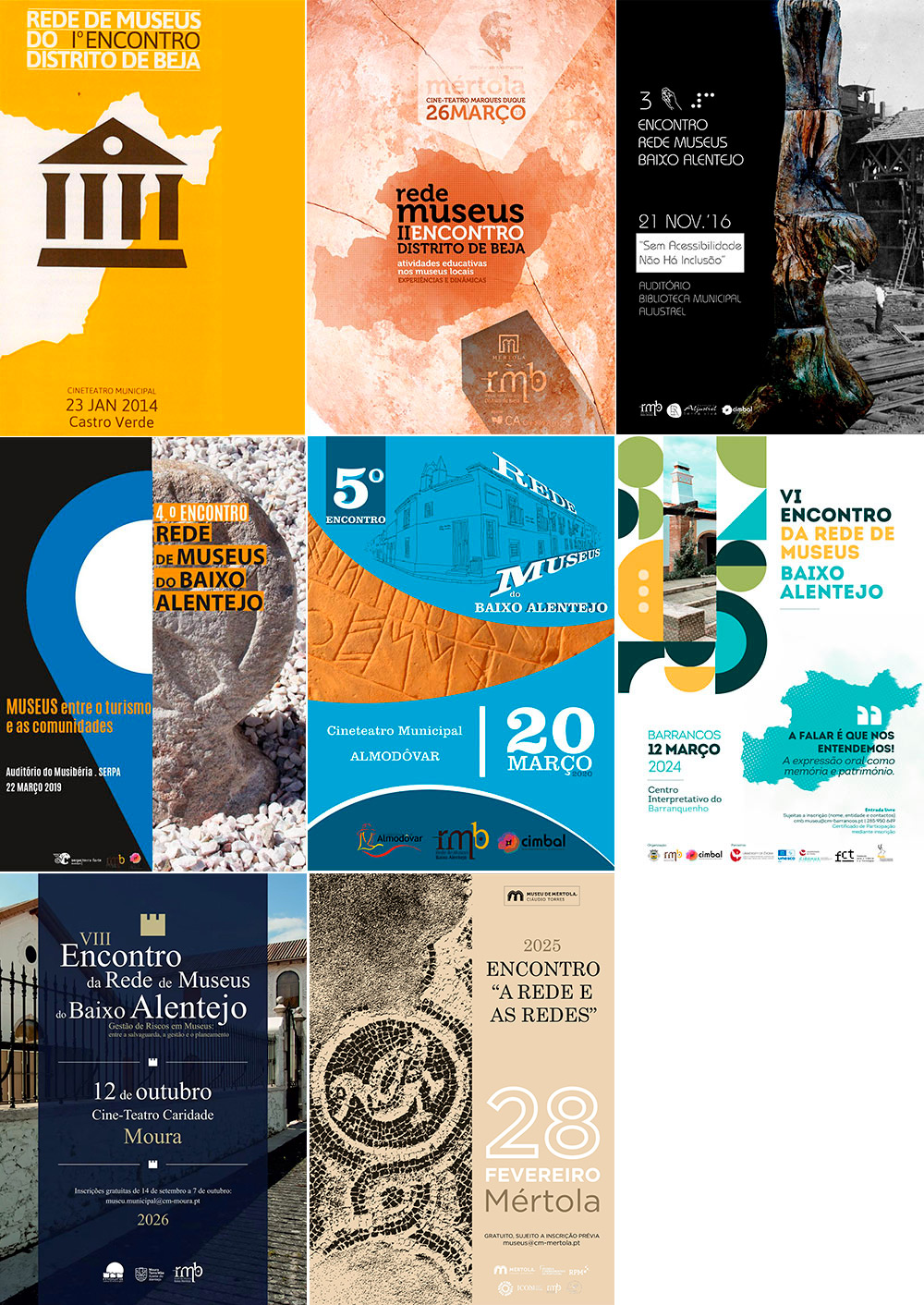
Main objectives of the RMBA (Metropolitan Region of Beja):
- Qualification, enhancement and dissemination of the museum units of this District;
- Cooperation, partnership and articulation between the museum units of the municipalities that are part of the Network;
- Optimization and profitability of resources, mainly in terms of human resources and the implementation of joint projects;
- Dissemination of information relating to the museums of the Network;
- Promotion of rigor, ethics and professionalism in museological practices.
https://redemuseusbeja.blogspot.com
https://cimbal.pt
The Lower Alentejo Museums Guide is a concise itinerary that presents its landmarks, unmissable museums that mark the identity of each place. Museums in Bahia are about witnessing and testing humanity, it's adventure, opportunity and discovery. It's the world, a home, a narrative that is a path traveled from generation to generation, it's evolution, knowledge and wisdom. It's about experiencing the free breeze of the air we breathe, hearing and witnessing its entire surrounding panorama. Memory, the records of History, are essential for understanding our behaviors in the past, in the present, and for knowingly envisioning the Future.