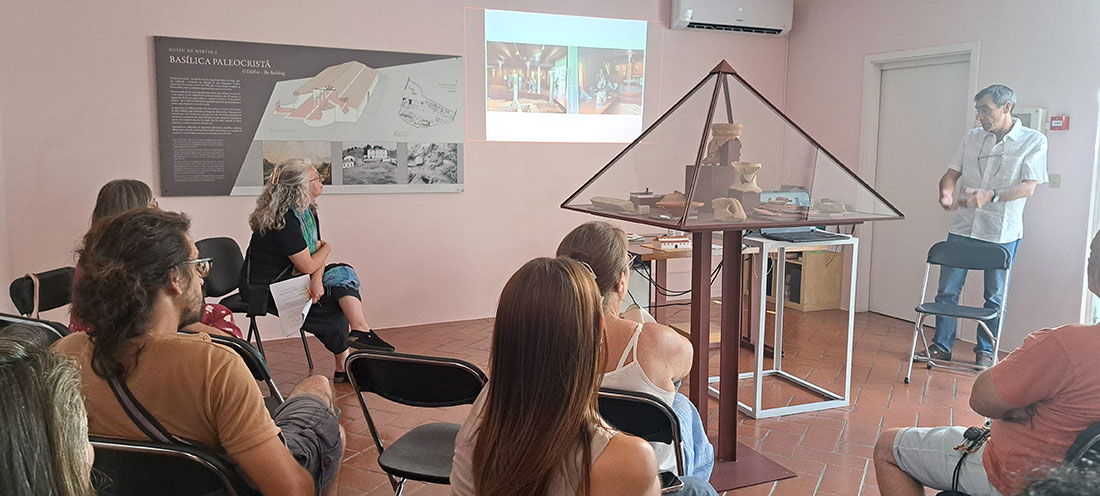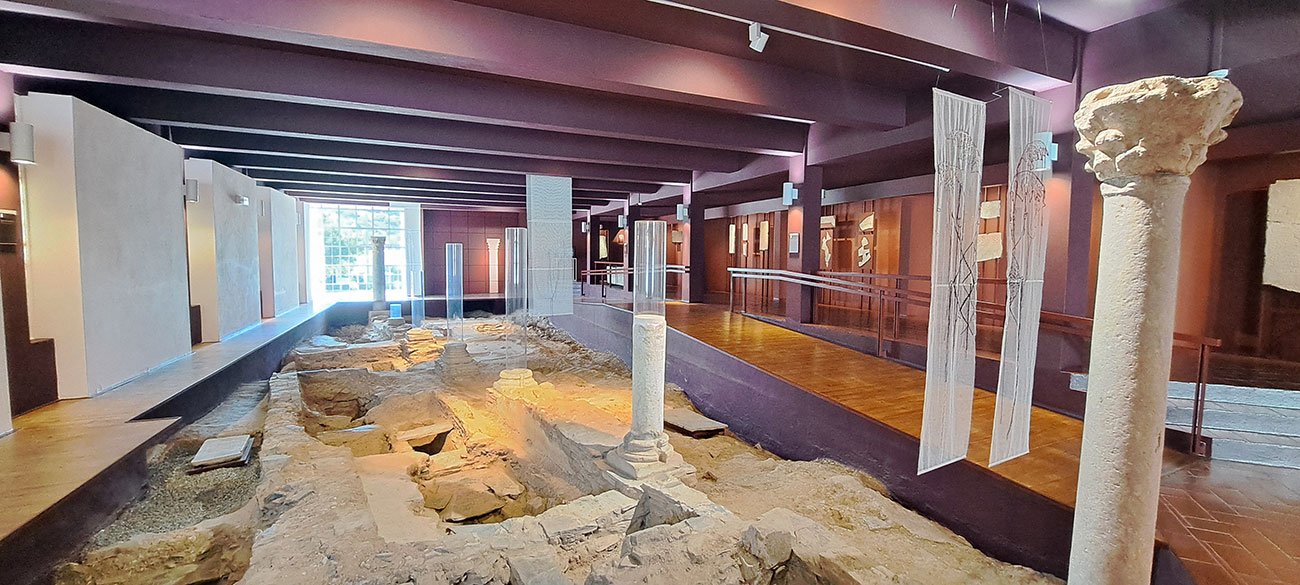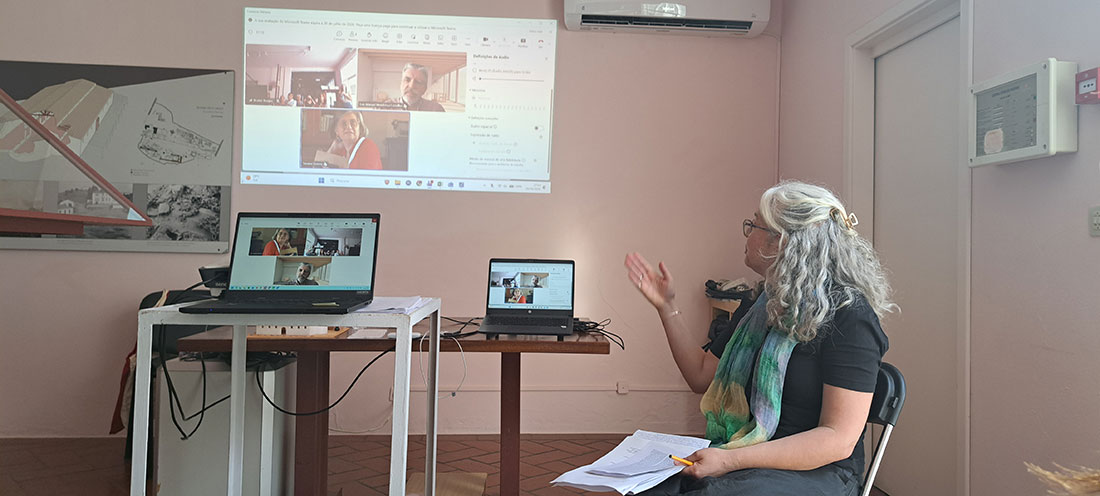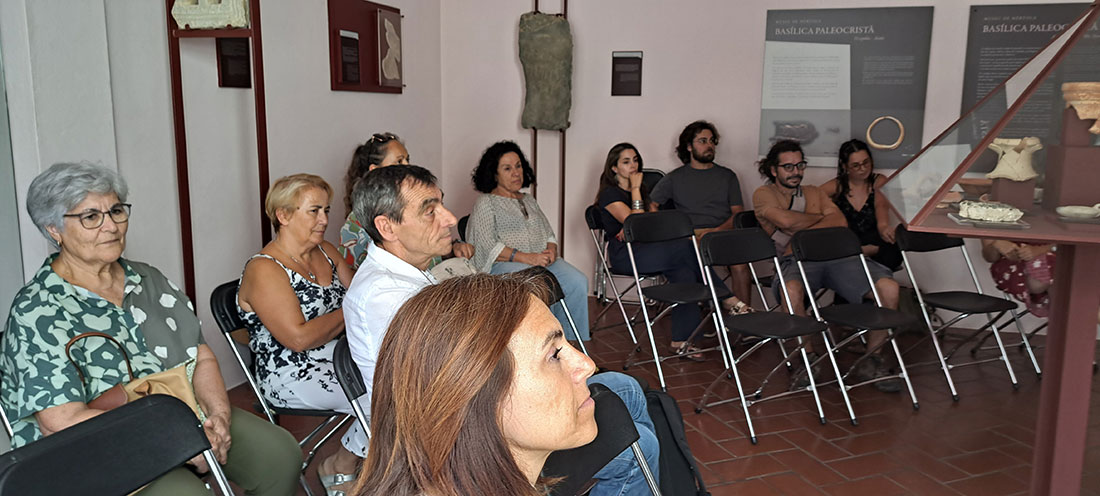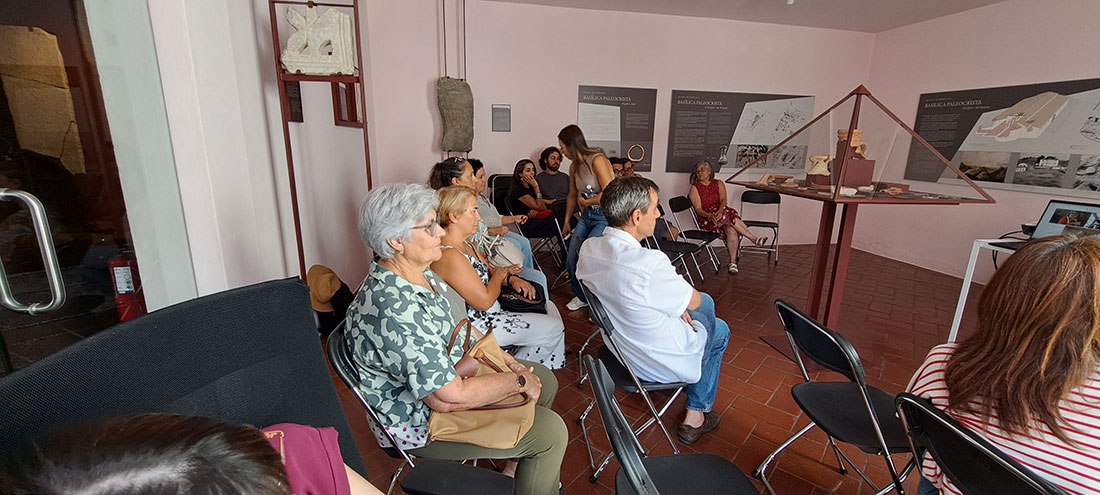




As part of the exhibition “O Sorriso do Acanto” (“The Smile of the Acanthus”)”, on display at the Basílica Paleocristã of the Museu de Mértola Cláudio Torres from 27 January to 28 June 2026, the talk “Um Acanto, um Cântaro e um Cantor – Ecos do Mediterrâneo Antigo Revolvido” (“An Acanthus, a Kantharos and a Singer – Echoes of the Revisited Ancient Mediterranean”)” took place on 26 June. The event was led by the exhibition’s creator, Sara Domingos, and featured Luís Mendonça de Carvalho, Susana Gómez Martinez and Virgílio Lopes.
Sara Domingos introduced the exhibition’s theme and explained the creative process, which takes the acanthus as its starting point. She explains that “one of the first surprises of this project was realising that observing plants could raise just as many questions as studying historical sources. Often the names remain the same, but the botanical correspondences are not always clear. In my case, it all began when I started wondering about the resemblance between the traditional representation of the acanthus and a mullein plant I came across along a path”. She further emphasised that, “there was one idea that emerged repeatedly throughout this research: the idea of passage. When I arrived in Mértola, I realised that the Basílica Paleocristã itself is a place of passage. It does not belong entirely to either the Roman world or the medieval world. It bears witness to a moment in which different traditions coexist, intersect and are transformed. At the same time, many narratives about the Mediterranean continue to focus on the Greco-Roman heritage. However, the more I researched, the more connections I found with the eastern Mediterranean and other geographical regions”.
In conclusion, she notes that “at a certain point, the research began to move away from the acanthus itself and towards the connections it suggested. One of the most striking examples was the kantharos, a cup deeply embedded in the imagery of Antiquity and frequently depicted alongside acanthus leaves. By following this line of enquiry, I realised that my research was taking me beyond the conventional boundaries of Classical Antiquity. Unexpected connections emerged with Sanskrit, Arabic and other cultural traditions. “Not as evidence of a common origin, but as echoes of recurring ideas associated with passage, connection, narrowing and transformation. Throughout this journey, I also came to realise that many of these connections first emerged as intuitions and only later found support in historical or archaeological evidence”.
The participants discussed a range of topics relating to nature and botany, history and archaeology, the representation of nature in art and its symbolism, and the relationship between societal transformations and the arts. Among the questions raised were the following: Where does the observation of nature end and the cultural construction of that nature begin? In light of the archaeological evidence from Mértola, how has our understanding of Late Antiquity changed? Does it still make sense to speak of Eastern influences, or does such terminology continue to reflect an outdated way of viewing the Mediterranean? What role did the medieval Islamic world play in preserving, transforming and transmitting this classical heritage? To what extent can contemporary art, through its dialogue with the past, serve as a means of mediating between the museum’s collections and its audiences?
This talk marked the closing of the exhibition “O Sorriso do Acanto” (“The Smile of the Acanthus”)”, which attracted 1,137 visitors. Our thanks to everyone involved, and in particular to Sara Domingos. We look forward to the development of new projects that celebrate cultural heritage and promote the collections of the Museu de Mértola Cláudio Torres.
Brief biographical notes on the participants:
Sara Domingos – Independent visual artist and creator of the exhibition “O Sorriso do Acanto” (“The Smile of the Acanthus”). She works across the fields of fine art, graphic arts and textile art, with a particular focus on dialogue between cultures (see: www.sara-domingos.wixsite.com ).
Luís Mendonça de Carvalho – Biologist, Coordinating Professor at the Polytechnic Institute of Beja, founder and director of the Beja Botanical Museum, and holder of the UNESCO Chair in Ethnobotany and the Safeguarding of Plant Heritage. His research focuses on ethnobotany, plant heritage, and the cultural relationships between human communities and plants.
Susana Gómez Martinez – Archaeologist and Historian. Assistant Professor and Head of the Department of History at the University of Évora; researcher at the CEAACP (Centre for Research in Archaeology, Arts and Heritage Sciences); and member of the Board of the Campo Arqueológico de Mértola. Her research focuses on the medieval and Islamic archaeology of the Iberian Peninsula, with particular emphasis on Mértola and the societies of the medieval Islamic world.
Virgílio Lopes – Archaeologist, researcher, and member of the Board of the Campo Arqueológico de Mértola. Associate Researcher at the CEAACP (Centre for Research in Archaeology, Arts and Heritage Sciences), he has been involved for several decades in the archaeological research projects carried out in Mértola, participating in and coordinating numerous excavation campaigns, including the work undertaken at the Basílica Paleocristã. His research focuses on the archaeology of Late Antiquity and the Islamic period in southern Portugal.